As an Amazon Associate, we earn from qualifying purchases. Some links on this site are affiliate links at no extra cost to you. Our recommendations are based on thorough research and editorial judgment.

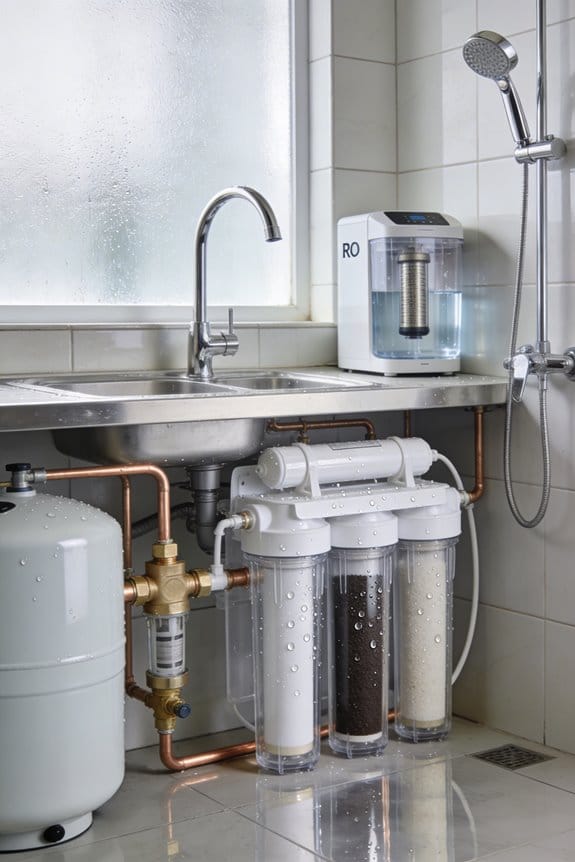
What the EPA Drinking Water Standards Actually Tell You About Your Tap

EPA drinking water standards tell you which contaminants your utility must monitor and remove, but they don’t guarantee your water is completely risk-free. These standards set acceptable exposure levels based on what’s technologically possible and economically feasible, not absolute safety. Your utility tests for regulated contaminants on set schedules, though hundreds of substances—like pharmaceuticals and industrial chemicals—aren’t federally regulated. Your state may enforce stricter limits than federal requirements. Understanding what’s actually tested, what isn’t, and your options for additional protection reveals the fuller picture behind those standards.
Key Takeaways
- EPA standards set acceptable contamination levels, not zero-risk guarantees, balancing health protection with feasibility.
- “Safe” MCL thresholds represent concentrations where detectable harm occurs at higher levels, not absolute safety.
- Your water utility must test according to EPA schedules; results available in Consumer Confidence Reports.
- Hundreds of unregulated contaminants like pharmaceuticals may exist in tap water without federal MCL requirements.
- States can enforce stricter limits than EPA standards; check your state’s specific requirements for your area.
What EPA Drinking Water Standards Actually Regulate
Because you rely on tap water for drinking, cooking, and cleaning, the EPA’s drinking water standards exist to protect you by controlling what contaminants can be in the water supplied by public water systems. These standards set maximum allowable levels for harmful substances, including microorganisms, chemicals, and radioactive materials. The EPA establishes legally enforceable limits called Maximum Contaminant Levels, or MCLs, based on the best available technology. Your local water system must conduct monitoring frequency tests according to EPA schedules, which vary depending on system size and water source. Compliance reporting requires systems to notify you if violations occur, ensuring transparency about water quality and any necessary treatment changes.
Safe Levels Aren’t the Same as Risk-Free
While the EPA sets Maximum Contaminant Levels to protect public health, I should understand that these “safe” limits don’t mean zero risk—they’re based on what’s feasible to achieve with current technology rather than what’s completely harmless. The MCL represents an acceptable exposure level that balances health protection with practical implementation. This policy interpretation acknowledges health tradeoffs; regulators accept some residual risk because eliminating contaminants entirely would be technologically impossible or economically unfeasible. These relative thresholds reflect what science shows causes harm at higher concentrations, not what causes no harm whatsoever. The EPA established bromate’s MCL at 0.010 mg/L because it’s detectable and reducible with available treatment methods, not because lower levels are completely safe. Understanding this distinction helps you recognize that compliance means manageable risk, not absolute safety.
Which Contaminants Your Utility Must Test For
Your water utility’s testing requirements stem from your system’s specific characteristics—including its size, the source of your water, and its operational history—rather than a one-size-fits-all approach. The EPA establishes monitoring schedules that vary based on risk factors. Utilities with higher contamination risks conduct more frequent sampling frequencies, while those with consistently clean water may qualify for reduced testing cycles. Each test uses EPA-approved methods to guarantee accuracy and reliability. When utilities detect elevated results or experience changes in land use, they trigger additional sampling. Method validation confirms that testing procedures meet federal standards. These customized requirements guarantee your utility monitors the contaminants most likely to affect your specific water supply.
How Often Your Water Gets Tested?
Testing schedules for drinking water aren’t fixed—they depend on your utility’s size, water source, and historical contamination patterns. Your water system follows a multi-year monitoring cycle, which means it doesn’t test for everything at the same frequency. Large systems typically sample more often than smaller ones because they serve more people and face greater operational risk.
When results show elevated contaminant levels, triggered monitoring kicks in immediately. This means your utility increases sampling frequency until contamination drops below safe limits. Land use changes near your water source can also trigger additional testing. The EPA requires strict adherence to approved methods and holding times, ensuring test results accurately reflect what’s actually in your tap water.
Common Tap Water Contaminants EPA Doesn’t Regulate
Even though the EPA sets strict limits on many dangerous contaminants, hundreds of substances can still show up in your tap water without violating federal standards. Unregulated contaminants include pharmaceuticals, personal care products, and industrial chemicals that aren’t currently monitored under national drinking water rules. Emerging pathogens, like certain viruses and resistant bacteria, present growing concerns as water treatment methods may not eliminate them effectively. Many states track these substances voluntarily, but there’s no federal requirement. Your water utility can provide details about what’s tested in your area. If you’re concerned about unregulated contaminants, consider using activated carbon filters or requesting your local water quality report, which lists all detected substances and their levels.
How Your State’s Standards Might Go Further
While federal EPA standards set a baseline for drinking water safety across the nation, many states have decided to establish their own regulations that are stricter than the national requirements. These state variances reflect regional water quality challenges and local health priorities that differ from federal benchmarks. For example, Nevada enforces a PFOA limit of 0.00266 parts per trillion, dramatically lower than the EPA’s 4 ppt standard, because groundwater contamination presents particular risks there. States can implement stricter limits on any contaminant, requiring their water systems to meet more protective thresholds. I’d recommend checking your state’s drinking water authority website to discover which contaminants face tighter regulations in your area, since your tap water may actually be safer than federal law requires.
What to Do If You’re Concerned About Your Tap Water
If you suspect a problem with your tap water, you have several reliable steps to take before jumping to conclusions. First, contact your local water utility to request a Consumer Confidence Report, which details what’s in your water and whether it meets EPA standards. You can also request specific test results for contaminants you’re worried about. For home testing, affordable kits are available, though they’re less all-encompassing than professional testing. If you’re concerned about safety, bottled alternatives provide temporary options while you investigate. Consider scheduling a professional water analysis through a certified lab for more detailed results. Your water provider can also recommend next steps if contamination’s detected. Don’t ignore persistent problems like discoloration or odors.
Frequently Asked Questions
How Do MCLS Compare to the Non-Enforceable Health Goals States Use?
MCLs are enforceable legal limits I must comply with, while MCLGs are non-binding health goals. I find MCLs often reflect treatment disparity—they’re set where technology allows, not always where maximum contaminant health protection begins.
What Specific PFAS Chemicals Does EPA Currently Regulate at Federal Level?
I’ll tell you the EPA currently regulates PFOA and PFOS at 4 ppt federally. Their PFAS inventory’s regulated analytes include PFHxS, PFNA, and HFPO-DA, though those MCLs face potential rescission. States often set stricter limits independently.
Why Might Monitoring Schedules Be Reduced for Certain Water Systems?
I’ll reduce your system’s sampling schedule if you’ve consistently shown low-risk results and don’t face seasonal exemptions that’d trigger increased monitoring. It’s about efficiency—we don’t oversample clean water supplies.
Are There Contaminants With State Limits More Stringent Than Federal MCLS?
Absolutely—states’ve gone nuclear with stricter limits than EPA’s. Nevada’s PFOA standard’s ridiculously tight at 0.00266 ppt versus federal 4 ppt. State standards and local variances often provide way stronger protections than federal MCLs allow.
What Recent Changes Should Water Systems Prepare for in 2026?
You’ll need to prepare for updated monitoring guidance in 2026, prioritize lead replacement requirements, and plan treatment upgrades to meet evolving compliance standards and technical assistance expectations.